FTSE Finish Line: June 16 — Peace Hopes Lift the Tape, Central Banks Keep a Lid on It
FTSE Finish Line: June 16 — Peace Hopes Lift the Tape, Central Banks Keep a Lid on It
London recovered on Tuesday as investors leaned back into risk on optimism around a preliminary U.S.-Iran peace deal, though the rally stayed measured while markets waited for the fine print and looked ahead to the Bank of England later this week. The FTSE 100 moved higher after Monday’s pullback, helped by banks, defence, aerospace and selected growth names. The global backdrop was supportive but not clean. Wall Street futures traded mildly higher, European benchmarks were broadly positive, and Asian markets finished mixed. The dollar was little changed, sovereign yields mostly eased, and oil continued to unwind its war premium, with both major crude benchmarks down more than 4%. Gold firmed, while cryptocurrencies mostly rallied. In Japan, government bond yields moved higher after the Bank of Japan delivered a rate hike, reminding investors that global central banks are still very much in play. The peace trade remained the dominant macro impulse. A possible U.S.-Iran agreement has reduced fears of a prolonged energy shock after the Middle East conflict and the disruption around the Strait of Hormuz. Lower oil prices are a relief for inflation, consumers and oil-sensitive sectors. But the market is not treating the deal as fully de-risked. The terms are still unclear, implementation risk is high, and the geopolitical risk premium is being removed before investors know exactly what replaces it. That uncertainty kept the FTSE’s advance from turning into a full chase. Investors bought the market, but selectively.
Banks were among the better performers. Barclays, NatWest, Standard Chartered, HSBC and Lloyds rose between 1% and 2%, supported by firmer risk appetite and a rates backdrop that still looks relatively friendly for net interest margins. With the Bank of England expected to hold Bank Rate at 3.75%, the sector is benefiting from the idea that policy will stay restrictive even as oil-led inflation pressure eases. Aerospace and defence also had a strong session. Rolls-Royce, BAE Systems, Convatec and Babcock International gained between 2.2% and 2.6%. The defence bid is notable: even with peace hopes rising, investors are not abandoning the structural defence-spending theme. The market is distinguishing between a near-term reduction in Middle East risk and a longer-term world of higher security spending. Growth and quality cyclicals also found buyers. Entain, Halma, Scottish Mortgage, Airtel Africa, IMI, Polar Capital Technology Trust, Smiths, 3i Group, Diploma and Fresnillo all moved notably higher. Halma’s continued rebound suggests some investors are willing to revisit quality names after last week’s guidance shock, while Scottish Mortgage and Polar Capital Technology Trust benefited from the broader improvement in risk appetite. But the rally was not broad enough to erase caution. Rentokil, BT, Pearson, Associated British Foods, Sage, Sainsbury, Kingfisher and Burberry fell between 1% and 2%. The weakness in retailers and consumer-facing names showed investors are still wary of the domestic demand backdrop, particularly ahead of UK CPI, labour-market data and the BoE decision. Hilton Food dropped 1.6% after confirming Mark Allen as group chief executive from July 1. The move was not dramatic, but it added to the softer tone across parts of the consumer and food supply chain.
The central-bank calendar remains the key constraint. Investors are waiting for the first FOMC decision under the new Fed Chair, which adds another layer of uncertainty to global rates. In the UK, the Bank of England is not expected to move this week, but the vote split will matter. A 7–2 hold is the clean base case, with Pill and Greene likely dissenting for a hike. A 6–3 hold would be more hawkish and could put upward pressure back into short sterling and gilt yields. The policy trade-off is still awkward. Lower oil helps the inflation outlook, but UK inflation expectations remain uncomfortable, and the labour market is weakening rather than breaking. That leaves the MPC trying to balance above-target inflation against slowing activity. Bailey’s centre of gravity still appears to favour patience, but the hawkish tail is alive.
Finish Line: The FTSE 100 bounced as peace hopes pushed oil lower and lifted risk appetite, with banks, aerospace, defence and selected growth names leading. But gains were capped by uncertainty over the U.S.-Iran agreement, the first FOMC under the new Fed Chair and the looming BoE vote split. This is a relief rally, not an all-clear: lower oil helps, but central banks still own the next move.
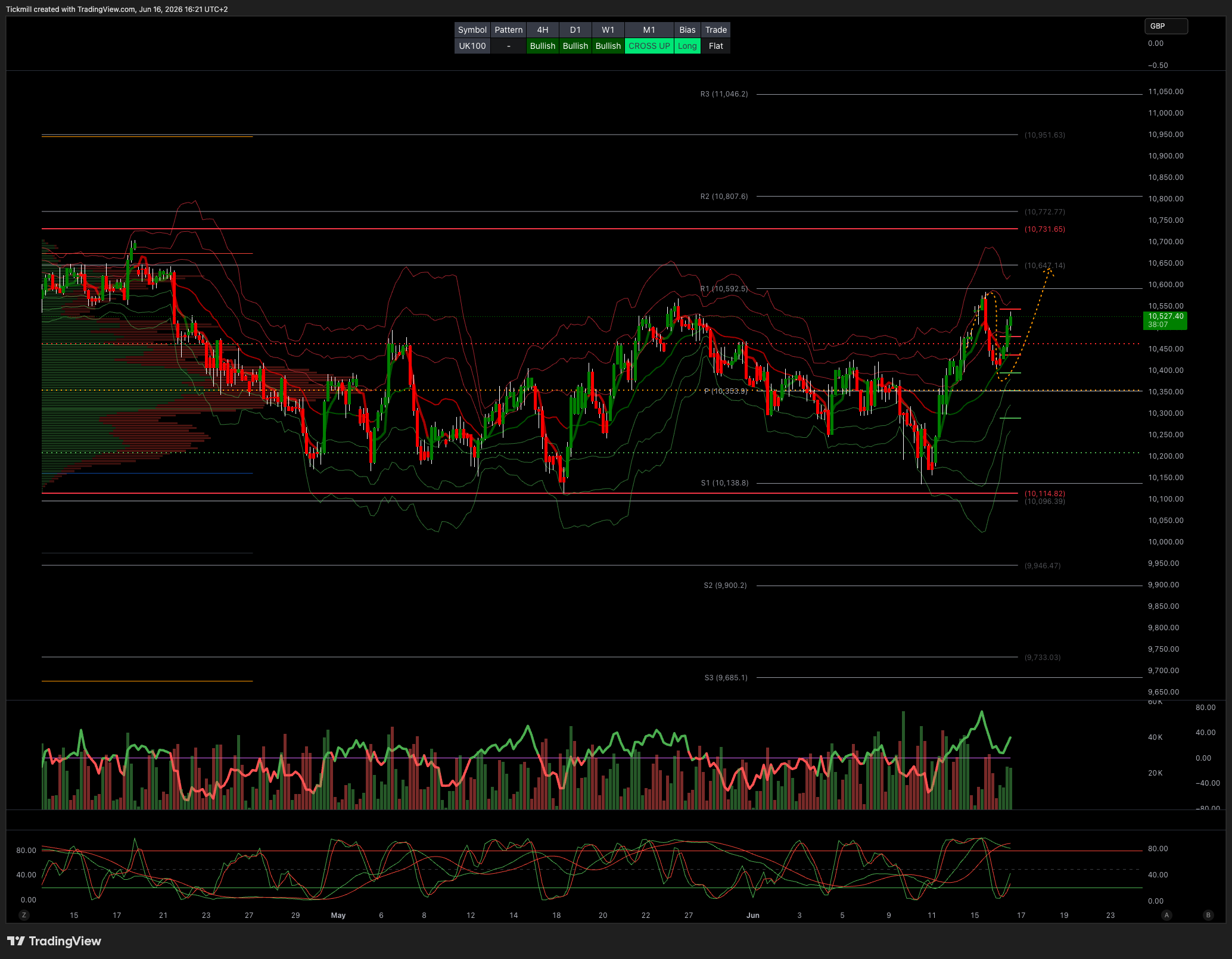
TECHNICAL & TRADE VIEW – FTSE100
Daily VWAP Bullish
Weekly VWAP Bullish
Above 10350 Target 11000
Below 10100 Target 9469
Disclaimer: The material provided is for information purposes only and should not be considered as investment advice. The views, information, or opinions expressed in the text belong solely to the author, and not to the author’s employer, organization, committee or other group or individual or company.
Past performance is not indicative of future results.
High Risk Warning: CFDs are complex instruments and come with a high risk of losing money rapidly due to leverage. 68% and 74% of retail investor accounts lose money when trading CFDs with Tickmill UK Ltd and Tickmill Europe Ltd respectively. You should consider whether you understand how CFDs work and whether you can afford to take the high risk of losing your money.
Futures and Options: Trading futures and options on margin carries a high degree of risk and may result in losses exceeding your initial investment. These products are not suitable for all investors. Ensure you fully understand the risks and take appropriate care to manage your risk.
Patrick has been involved in the financial markets for well over a decade as a self-educated professional trader and money manager. Flitting between the roles of market commentator, analyst and mentor, Patrick has improved the technical skills and psychological stance of literally hundreds of traders – coaching them to become savvy market operators!